Wildlife in Corcovado National Park Costa Rica — Complete Species Guide

National Geographic called Corcovado National Park the most biologically intense place on Earth — and the wildlife backs it up. The park protects 424 km² of primary rainforest on the Osa Peninsula, home to all four Central American monkey species, the endangered Baird's tapir, American crocodiles, Baird's peccaries, giant anteaters, and a bird list that exceeds 500 species. What makes Corcovado different from other wildlife destinations is density. Because the park has never been logged, the forest is old-growth from the canopy to the forest floor. Food chains are intact, apex predators still regulate prey populations, and wildlife encounters happen at a frequency that feels almost impossible — tapirs in the morning, scarlet macaws at noon, crocodiles in the lagoon, monkeys all day long. This guide covers what wildlife you'll realistically see on a guided Corcovado tour, what's rarer but possible, and the best strategy for maximising sightings.
Wildlife at a Glance — What You Can Expect
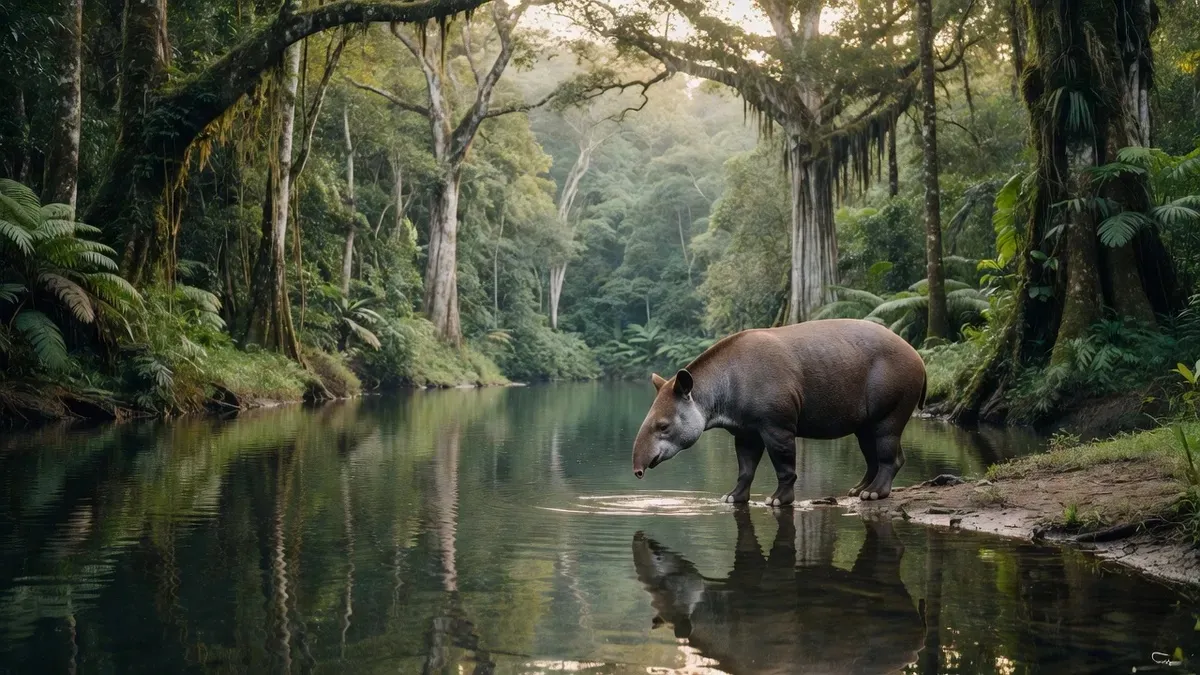
Frequently seen near Sirena lagoon — largest land mammal in Central America
Howler, spider, capuchin, and squirrel monkeys in the same park
Guaranteed sighting on almost every tour — nesting in canopy year-round
Resident at Sirena lagoon — reliably spotted from the bank
Present in the park but rarely seen — tracks and scat more common than sightings
Including harpy eagle, toucans, trogons, and 16 hummingbird species
Book a Guided Wildlife Tour — Check Availability
Wildlife density at Sirena Station is highest in the early morning hours — the reason all Corcovado tours depart at dawn. This best-value tour from Drake Bay reaches Sirena with a 5-hour hike and lunch included at $110. Check your dates now.
Animals You Will Almost Certainly See
Baird's Tapir — Corcovado's Signature Animal
The Baird's tapir is the largest land mammal in Central America — a prehistoric-looking creature that resembles a cross between a pig and an anteater, with a prehensile upper lip and thick charcoal-grey hide. It is classified as endangered across its range, but at Sirena Station it behaves like a resident — frequently seen at the lagoon edge in the early morning hours, sometimes walking within metres of the trail.
At Corcovado, tapirs have lost their fear of humans over decades of protection, which is why encounters here feel extraordinary compared to anywhere else in their range. Guides position guests patiently and use hand signals — if you're quiet, a tapir encounter can last 10–20 minutes at very close range.
- Best location: Sirena lagoon edge, early morning (6:00–9:00 am)
- Encounter quality: often within 10–20 metres on the main Sirena trails
- Photography: low light at dawn — a fast lens (f/2.8 or faster) makes a big difference
- Status: endangered — Corcovado has the highest tapir density in Central America
All Four Monkey Species
Corcovado is one of the only places on Earth where you can reliably see all four Central American monkey species in a single day: howler monkeys, spider monkeys, white-faced capuchins, and tiny squirrel monkeys. All guided Corcovado wildlife tours on this site include an ICT-certified naturalist whose job is finding them for you. Howler monkeys announce themselves at dawn with a guttural roar that carries 3 km through the forest — their sound is typically the first wildlife encounter of the morning. Spider monkeys move in the upper canopy, using their prehensile tails to swing between branches. Capuchins are the most visible, descending to mid-canopy and sometimes ground level. Squirrel monkeys travel in large, fast-moving troops of 20–40 individuals — when a troop passes overhead, it's a spectacle.
All four species are reliably seen on guided Corcovado tours — not possible but typical. On any given Sirena trail hike, you will encounter at least two species, and usually three or four.
Scarlet Macaw
Scarlet macaws are the most photogenic and loudest residents of Corcovado. They move in bonded pairs and small flocks, nesting in the large ceibo trees along the Sirena trails and at San Pedrillo's coastal forest. Their flight path — long tail streaming behind them, crimson and gold wing flash visible 200 metres away — is one of the most dramatic sights in Neotropical birding.
Macaws are the most reliable of the headline species, vocal and mobile even in poor weather, though no guide can promise one. The coastal forest at San Pedrillo Station has some of the highest nesting density in the park.
American Crocodile
The freshwater lagoon at Sirena Station is reliably populated by American crocodiles — large, wild individuals that bask on the banks and move through the water with deceptive speed. The guide maintains safe viewing distance, but close encounters with crocodiles up to 3 metres are typical on the lagoon perimeter walk. These are not zoo animals — they are completely wild, fed only by the fish and mammals of the lagoon ecosystem.
- Best location: Sirena lagoon bank and the Rio Sirena estuary
- Typical size: 1.5–3 metres on the lagoon, larger animals in the deeper estuary
- Activity: most visible basking midday, active and swimming in early morning
- Safety: guide maintains minimum safe distance — follow all instructions
Animals That Are Present But Rarely Seen
Jaguar and Puma
Corcovado has a healthy population of jaguars and pumas — estimated at 40–50 jaguars, the most of any Central American protected area outside of Mexico. Seeing one on a day tour is rare. The chances improve significantly with an extended stay or overnight at Sirena Station, where nocturnal activity is higher.
What is commonly seen: tracks, scat, and — more reliably — the evidence of jaguar predation. Turtle nesting beaches on the park's Pacific coast show jaguar sign frequently. Guides know the active corridors and will show you tracks even if the animal is long gone.
- Sighting probability on a day tour: low (approximately 5–10% based on guide reports)
- Best strategy: multi-day stay at Sirena Station with early-morning and evening walks
- What you will see: tracks and scat — guides interpret these in detail
- Status: Corcovado has the highest jaguar density in Central America outside Mexico
Giant Anteater and Giant Armadillo
Both species are present in Corcovado but rarely seen during daytime tours. Giant anteaters are primarily nocturnal, foraging for termite mounds after dark. Giant armadillos similarly avoid daylight.
Camera-trap studies show both species active at Sirena in the night hours — overnight visitors occasionally spot them at dusk.
- Giant anteater: primarily nocturnal — day sightings rare but documented
- Giant armadillo: nocturnal and fossorial — almost never seen on day tours
- Best strategy: overnight stay at Sirena with a night walk included
Harpy Eagle
The harpy eagle is the most sought-after bird sighting in Corcovado — the largest eagle in the Americas, with a 2-metre wingspan and talons the size of grizzly bear claws. A confirmed nesting pair has been documented in Corcovado, and sightings, while exceptional, are more likely here than anywhere else in Costa Rica. Your guide will know the most recent sighting locations and will actively look for the species near known roosting trees.
Tips for Maximising Wildlife Sightings
Arrive at Sirena During the Peak Morning Window
Wildlife activity in Corcovado is dramatically higher between 6:00 and 10:00 am — the reason all tours depart before dawn. The early hours are when tapirs are still at the lagoon, monkeys are moving through the lower canopy feeding, birds are vocal and visible, and the forest temperature is cool enough that reptiles are active but not yet hiding from midday heat. Tours that reach Sirena by 7:00 am consistently have better sightings than any alternative.
- Peak activity window: 6:00–10:00 am on the main Sirena trails
- Drake Bay tours: depart at ~6:30 am, arrive at Sirena by ~7:15 am
- Puerto Jimenez tours: depart at 5:30 am, arrive at ~7:00 am — earliest start
- Uvita tours: depart at ~6:30 am, arrive at San Pedrillo by ~8:00 am
Use Binoculars and the Guide's Scope
In a tall primary forest with a 60-metre canopy, 80% of wildlife is not visible to the naked eye. Binoculars transform a possible sighting into a confirmed one — they reveal spider monkeys silhouetted against the sky, toucans perched in distant tree tops, and raptors riding the air above the canopy edge. Most guides provide a spotting scope, but personal binoculars allow you to scan independently while the guide directs the group.
Minimum 8x42 magnification is recommended.
- Recommended: 8x42 binoculars — compact enough for the trail, powerful enough for canopy
- Guide scope: positioned for stationary animals — excellent for photography
- Personal binoculars: allow scanning while the guide watches something else
- Camera: 200–400mm zoom lens for canopy wildlife; fast shutter speed in low forest light
Wildlife in Corcovado — Frequently Asked Questions
Is a jaguar sighting realistic in Corcovado?
Corcovado has the highest jaguar density in Central America outside Mexico, but sightings on a single day tour are rare — around 5–10% based on guide estimates. Overnight stays at Sirena Station dramatically increase the odds, as does visiting with a small-group tour that moves slowly and quietly. What is reliable: jaguar tracks and scat along known corridors, which your guide interprets in detail.
Will I definitely see a tapir in Corcovado?
Tapir sightings at Sirena Station are very common but not guaranteed. The Sirena lagoon edge is the most reliable location — early morning is best. On most dry-season tours, tapir encounters are reported in the 70–80% range by guides. In the rainy season, when the forest is murkier and trails muddier, sightings are slightly less frequent but still probable.
How many bird species can I see in a single day tour?
Experienced birders on guided Corcovado tours typically count 60–100 species in a single day at Sirena or San Pedrillo Station. Scarlet macaws, toucans (several species), multiple flycatcher and warbler species, trogons, motmots, and various raptors are consistently spotted. The park's 500+ species means even a brief visit yields a rewarding list. Dedicated birding tours are available that move more slowly and specifically target hard-to-find species.
Are all four monkey species really in the same park?
Yes — Corcovado is one of only a handful of places in Central America where all four species co-exist: mantled howler monkey, Geoffroy's spider monkey, white-faced capuchin, and Central American squirrel monkey. Seeing all four in a single day is possible and is reported by guides regularly. Howlers are typically heard before dawn; squirrel monkey troops pass through midmorning; capuchins are active all day; and spider monkeys favour the high canopy in the late morning hours.
What is the rarest animal in Corcovado National Park?
The harpy eagle is arguably the rarest large-animal sighting in Corcovado. The giant anteater and giant armadillo are also rarely seen due to their nocturnal habits. The Baird's tapir is endangered but paradoxically one of the easiest to see in the park — decades of protection mean Sirena's tapirs have become habituated to respectful human presence.